Stack job list
Every tool earns its place by doing one clear job.
Guide 03 / SP-STK-03
Choose the smallest tool stack that can catch buyers, explain the offer, deliver the work, remember proof, and let AI control the repeatable parts safely.
Build the stackBack to library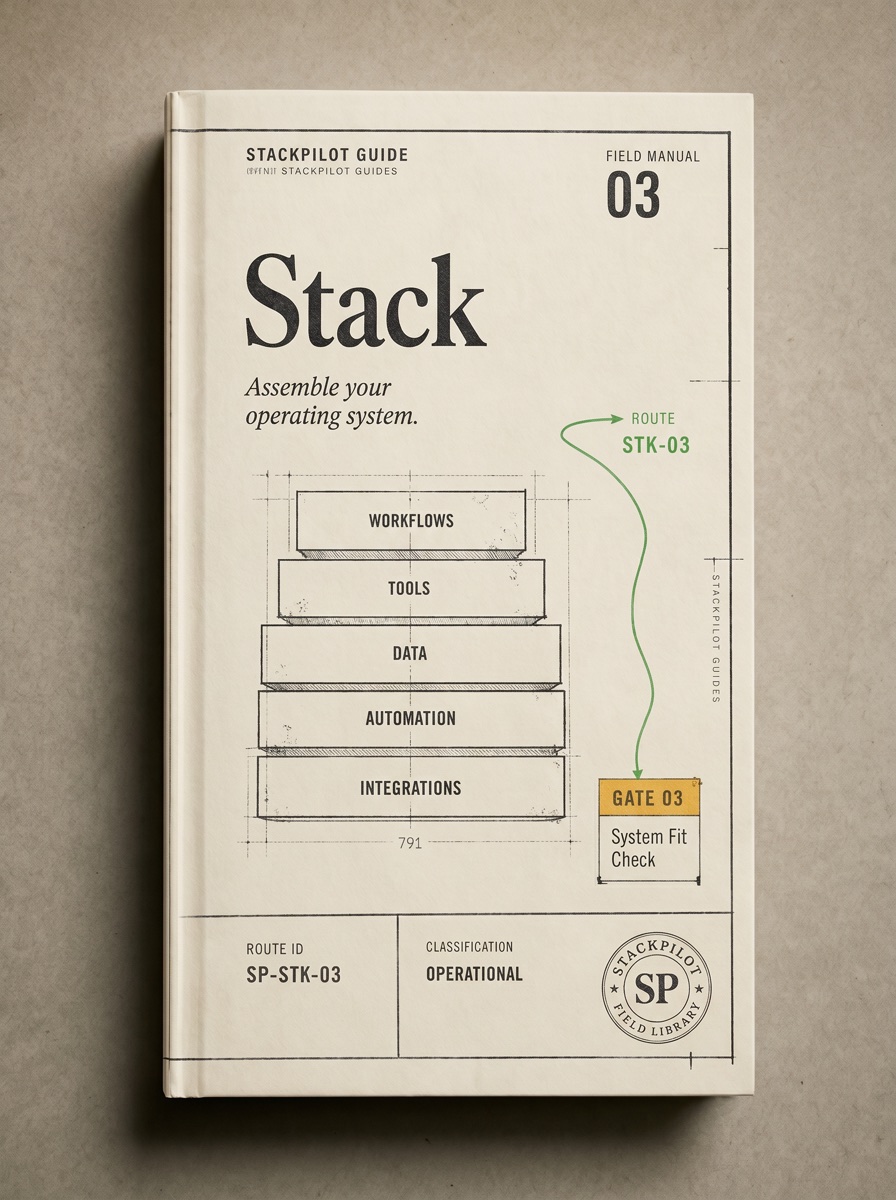
Mission outcome
Every tool earns its place by doing one clear job.
Catch, talk, sell, do, remember — simple enough to explain.
Use the right AI strength for strategy, code, transcripts, QA, and reports.
10-year-old rule
If a bright kid cannot point to a tool and say what job it does, the stack is too confusing. Do not buy tools because they look powerful. Buy or use them because they help the current offer run.
Worksheet
What are you selling?
Who needs this?
What useful thing will exist?
Where does the workflow still feel messy?
Five-lane operating map
Landing page, diagnostic, form, email signup, or referral link.
Inbox, CRM, spreadsheet, or simple owner review list.
Offer page, booking link, invoice, or checkout once approved.
Checklist, report, guide, template, workflow, or AI workspace.
Notes, customer log, proof folder, next steps, and learning.
Tool/no-tool test
Business memory
AI cannot control a business safely if the business has no memory. Start with files that make decisions visible.
Model routing
AI may control first
Let AI control preparation and memory before it controls anything public.
Human approval gate
The system may prepare these actions. A human approves the risk.
Final checklist
A stack is just a small team of tools. Each tool needs a job. If you cannot say the job in one sentence, do not add the tool yet.
AI may organize files, draft stack maps, compare tools, summarize transcripts, and prepare routing notes. A human approves purchases, accounts, integrations, deployment, and live customer data access.