Guide 07 / SP-DLV-07

Delivery System Manual

Turn sold work into a calm, repeatable system: fulfillment checklist, customer handoff, revision boundaries, proof capture, feedback, and safe AI-assisted delivery support.

Build the delivery checklistBack to library
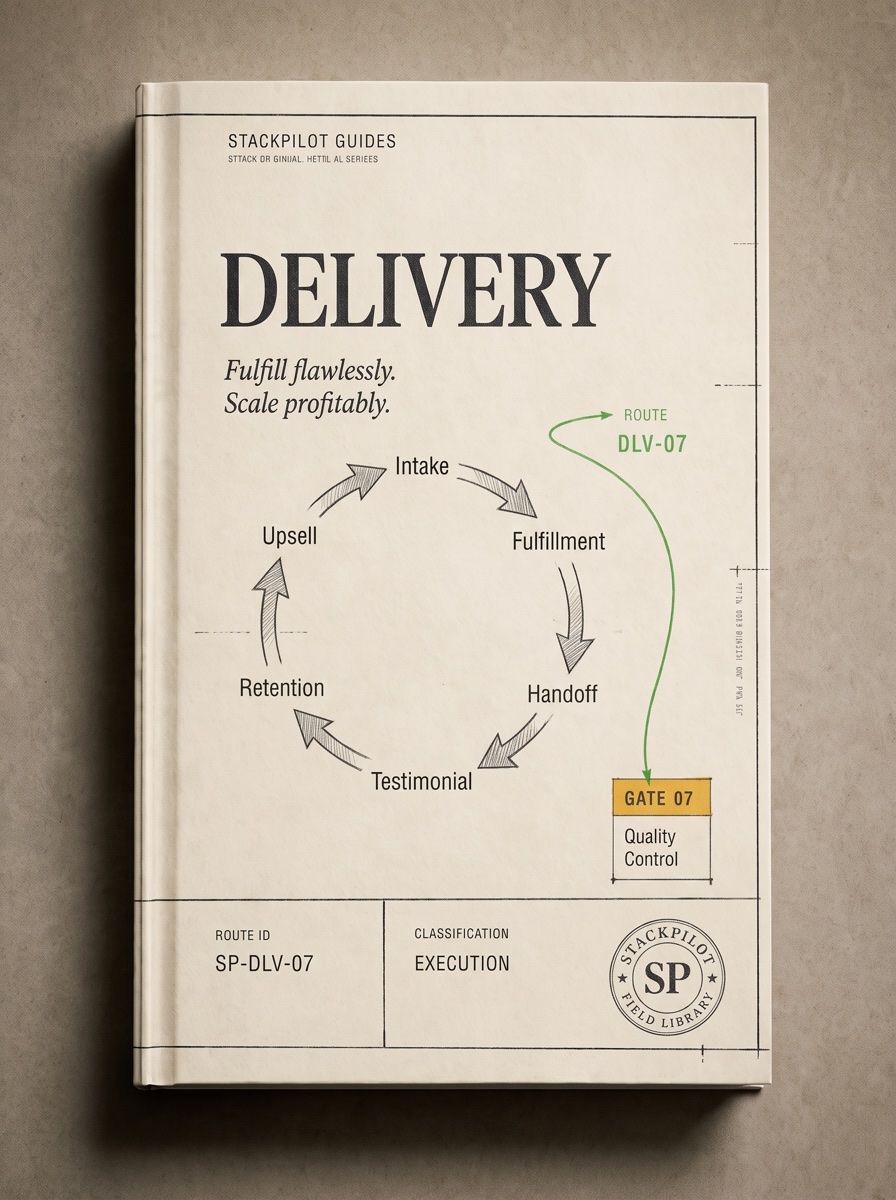
StackPilot Delivery System guide cover
Time60 minutes
DifficultyIntermediate
OutputFulfillment checklist + SOP
AI levelQA and drafts only

Mission outcome

At the end of this manual, you will have:

Beginner

Do what you promised.

Write the result, collect inputs, do the visible steps, and hand off the work clearly.

Intermediate

Stop reinventing delivery.

Use one checklist for scope, QA, revisions, proof, feedback, and follow-up.

Advanced

Build review-only delivery ops.

Let AI prepare checklists, drafts, QA notes, and SOP files while humans approve quality and customer-facing actions.

Output 01

Fulfillment checklist

Promise, inputs, work blocks, QA, handoff, feedback, and SOP update.

Output 02

Revision boundary

A plain rule that separates fixing the agreed deliverable from new scope.

Output 03

Proof + SOP loop

Capture permissioned proof and turn repeated work into safer templates.

Promise rule

If the promise is fuzzy, delivery will be messy.

Before delivery starts, write the result, included scope, excluded scope, customer inputs, review point, and done condition in one plain sentence.

10-year-old mode

Delivery means doing what you said.

We promised this result. We need these inputs. We will do these steps. A human checks the work before the customer sees it.

Fulfillment checklist

Seven lanes make delivery visible.

01 Promise

What was approved?

Result, scope, boundary, timeline, and done condition.

02 Inputs

What do we need?

Customer materials, examples, notes, access, and constraints.

03 Work blocks

What are the steps?

The smallest visible blocks from kickoff to handoff.

04 QA

What must be checked?

Truth, links, claims, privacy, math, design, and usability.

05 Handoff

How will they use it?

What changed, how to review, and what comes next.

06 Feedback

What happened?

Approved, revision, objection, follow-up, or no next step.

07 Proof / SOP

What can repeat?

Permissioned proof, anonymized lesson, template, or SOP update.

Customer promise

What exact result did we agree to deliver?

Inputs needed

What files, notes, examples, decisions, or access are required?

Work blocks

What are the 3–7 visible steps from start to handoff?

QA checks

What must be true before the customer sees it?

Revision boundary

What is included, and what becomes new scope?

Proof / SOP lesson

What can be reused with permission and private details removed?

Intermediate workflow

Make every delivery teach the next one.

01

Restate the promise

Confirm result, inputs, boundary, timeline, and review point.

02

Work in visible blocks

Move from inputs to draft to QA to handoff.

03

Review before customer view

Check truth, privacy, claims, links, and scope.

04

Capture proof and SOP

Save feedback, permission, reusable steps, and next improvement.

Advanced workflow

Build review-only delivery ops.

Create statuses for kickoff, waiting on inputs, in progress, QA, customer review, revision, approved, proof captured, and SOP updated. Give AI only named draft actions: summarize brief, make checklist, draft handoff, check scope, flag missing inputs, draft FAQ, and create local SOP file.

Safe AI delivery loop

AI prepares delivery work. Humans own quality.

ReadApproved brief, inputs, scope, and constraints.
PrepareChecklist, work plan, QA notes, handoff draft, SOP draft.
CheckCompare finished work against promise, privacy, and claims.
ApproveHuman reviews before customer contact, publish, deploy, or live changes.

QA before handoff

Seven checks before the customer sees it.

  1. The delivered work matches the approved promise.
  2. Scope boundaries are still clear.
  3. Links, files, forms, calculations, and instructions were checked.
  4. Private data is protected.
  5. Claims are truthful and do not imply guaranteed results.
  6. A human approved the handoff note.
  7. Follow-up and revision expectations are clear.

Revision boundary

A revision fixes the agreed deliverable. New scope changes the promise.

Type
Included revision
New scope
Content
Clarify confusing wording or correct a mistake.
New audience, offer, page, campaign, or guide.
Inputs
Add missing information that was already approved.
New customer data, platform, or business decision.
Automation
Fix the checklist or local draft instructions.
Live account changes, deployment, credentials, sending, or integrations.

Handoff note

Make the customer feel oriented, not abandoned.

What we built

Restate the approved artifact and result in plain language.

How to use it

Give the first action, review path, and owner instructions.

What is included

Name the revision boundary so fixes do not become scope creep.

What proof helps

Ask for feedback, quote permission, or anonymized result only after real use.

Do not do this

Do not let delivery create risk.

  • No fake proof or invented testimonials.
  • No live customer changes without approval.
  • No silent scope creep.
  • No sending files or messages automatically.
  • No using private details or credentials in AI tools casually.

Do this instead

Turn good work into a system.

  1. Save the promise and inputs.
  2. QA against the promise.
  3. Hand off with clear next steps.
  4. Capture feedback and permission.
  5. Update the SOP after delivery.
  6. Use the lesson to improve the next offer.
Readiness checklist

Ready to deliver?

You are ready when the promise, inputs, QA, handoff, revision boundary, and human approval gate are visible.

Ready. Begin Manual 07.
Safety lock

Delivery quality is human-owned.

AI may summarize, organize, compare, draft, check, anonymize draft notes, remind, and create local files. Human approval is required before sending, publishing, deploying, contacting people, changing live customer systems, deleting records, accepting terms/contracts, entering credentials, or using private payment/tax/legal/KYC/identity details.

  • Never invent results, testimonials, screenshots, logos, customer quotes, or revenue.
  • Never publish proof without permission and private-detail removal.

Route complete

The first StackPilot path is complete.

Buyer → offer → stack → agents → content → customers → delivery. If you want the beginner-safe route, use the Start Here worksheet pack to finish one artifact per day.

Open Start Here pack Back to guide library